
Start with Words You Can Actually Use
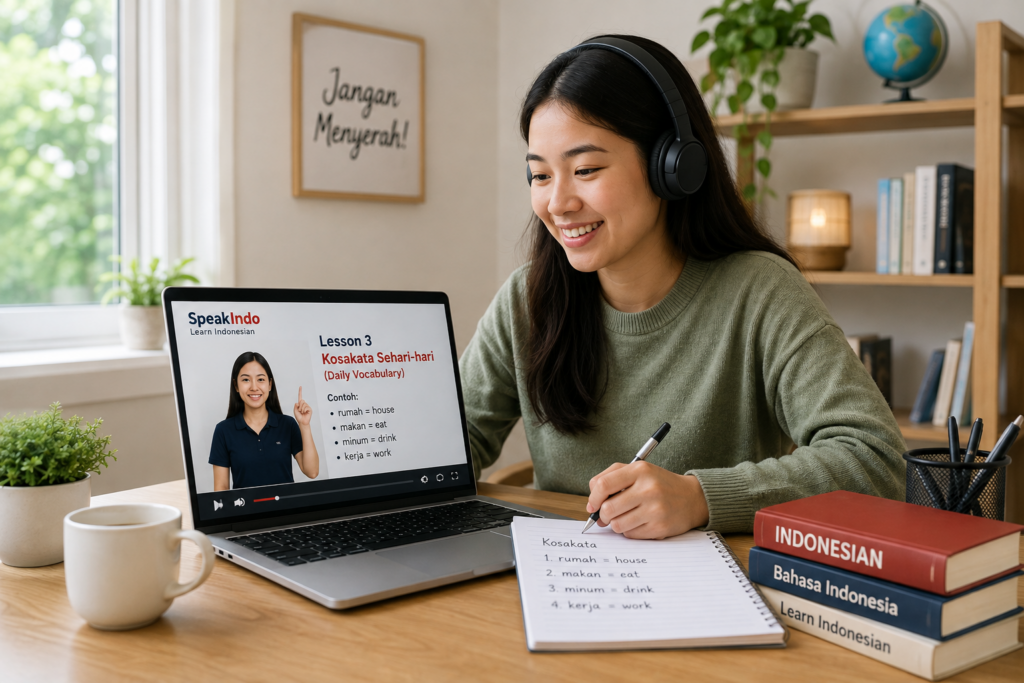
Learning Indonesian vocabulary for beginners does not mean memorising hundreds of words at once. A better approach is to start with useful words that appear in everyday conversations. Greetings, food, numbers, family, and simple questions can quickly give you the tools to communicate.
Many new learners make the mistake of studying long vocabulary lists without context. A word may stay in your memory for a day or two, but it can disappear quickly when you never use it. SpeakIndo takes a more practical approach. New vocabulary is connected to useful situations, listening activities, and simple conversations. As a result, students learn not only what a word means but also how to use it.
Why Vocabulary Matters
Words are the building blocks of every conversation.
You cannot ask for directions without knowing words related to places. Ordering food becomes difficult when you do not recognise basic restaurant terms. Even introducing yourself requires a small set of useful expressions.
However, learning more words is not always the same as making more progress.
Imagine memorising 500 random Indonesian words. You might know the names of many objects but still struggle to ask someone how they are.
Now imagine knowing 100 carefully chosen words and phrases for everyday situations. That smaller vocabulary may already allow you to have basic conversations.
For beginners, useful words matter more than large numbers.
Begin with Indonesian Greetings
Greetings are a natural place to start because they can be used immediately.
Here are a few important examples:
- Halo – Hello
- Selamat pagi – Good morning
- Selamat siang – Good afternoon
- Selamat malam – Good evening
- Apa kabar? – How are you?
- Baik – Good / Fine
- Terima kasih – Thank you
- Sampai jumpa – See you
Try saying each expression aloud instead of only reading it.
Hearing your own voice helps you become more comfortable with Indonesian pronunciation. Later, use two or three expressions together to create a short conversation.
Useful Words for Everyday Life
After learning greetings, move to words that you can use throughout the day.
Some useful verbs include:
- Makan – Eat
- Minum – Drink
- Pergi – Go
- Datang – Come
- Belajar – Study
- Bekerja – Work
- Tidur – Sleep
- Beli – Buy
These words become much more valuable when you put them into simple phrases.
For example, saya makan means “I eat,” while saya minum means “I drink.” With only a few words, you are already moving beyond vocabulary lists and creating Indonesian sentences.
That is the goal.
Learn Words in Groups
Random vocabulary can be difficult to remember.
Grouping words by topic gives your brain a stronger connection between them. Food words can be learned together, while family vocabulary belongs in another group.
A beginner could use categories such as:
- Food and drinks
- Family
- Home
- Work
- School
- Shopping
- Transport
- Time
- Weather
- Hobbies
Choose one category and focus on it for a few days.
Afterwards, review older groups before starting something new. This simple method prevents too much information from arriving at once.
Use Vocabulary in Short Sentences
A single word has limited value until you know how to use it.
Suppose you learn the word rumah, meaning “house” or “home.” Instead of repeating rumah ten times, create a simple phrase.
Saya di rumah.
I am at home.
Next, take the word kerja, which relates to work.
Saya bekerja hari ini.
I work today.
Short examples help connect meaning with real communication.
You do not need complicated sentences. At beginner level, simple language is often the best language.
Listen to the Words You Learn
Reading vocabulary is only one part of language learning.
You also need to recognise words when someone says them. Without listening practice, familiar vocabulary can suddenly sound unfamiliar during a real conversation.
Audio solves part of this problem.
Listen to a new word several times. Afterwards, repeat it aloud and try to copy the pronunciation.
Once individual words feel comfortable, listen to them inside short sentences.
This method connects reading, listening, and speaking instead of treating them as separate skills.
Review Instead of Constantly Adding New Words
Beginners often want to learn something new every day.
New material feels exciting, but review is just as important.
Imagine learning twenty words today and another twenty tomorrow. By the end of the week, you may have seen 140 words but forgotten half of them.
A smaller target can work better.
Learn five or ten useful words. Review them the next day, then return to them again later in the week.
Repeated contact helps vocabulary stay in your memory for longer.
Turn Vocabulary into Conversation
Eventually, words need to leave your notebook.
Start using them.
If you know someone who speaks Indonesian, try a simple greeting. Ask an easy question or mention something about your day.
No speaking partner? Practise aloud.
Describe what you are doing:
Saya makan.
I am eating.
Saya minum kopi.
I am drinking coffee.
Saya belajar Bahasa Indonesia.
I am studying Indonesian.
These small exercises train your brain to find Indonesian words without depending on translation every time.
How SpeakIndo Helps You Build Vocabulary
SpeakIndo does not teach vocabulary as a collection of unrelated words.
Instead, language is introduced through clear topics and practical situations. Students can see a new word, hear its pronunciation, and then use it during practice.
The course includes:
- Video lessons
- Indonesian audio
- Everyday vocabulary
- Reading activities
- Speaking practice
- Exercises
- Lesson quizzes
- Flexible online access
Each activity helps strengthen what you have already learned.
Rather than memorising vocabulary once and moving on, students meet useful language in different ways throughout the learning process.
Learn at Your Own Speed
People remember vocabulary at different speeds.
One learner may remember a new word after hearing it twice. Someone else might need to review it several times.
Both are normal.
Online learning allows you to repeat material without worrying about the speed of a classroom. Pause a video, replay audio, or return to an earlier lesson whenever necessary.
This freedom is especially helpful for beginners.
Your goal should be steady progress rather than learning as quickly as possible.
Make Indonesian Part of Your Day
Language becomes easier to remember when you see it regularly.
Try adding Indonesian to small parts of your daily routine.
Place Indonesian names on objects around your home. Change a few simple notes on your phone. Listen to short audio while drinking coffee or travelling.
Even five minutes can help.
Another useful habit is keeping a small vocabulary notebook. Write the Indonesian word on one side and its meaning on the other. Add a short sentence whenever possible.
Soon, Indonesian starts becoming part of your normal day instead of something you only see during lessons.
Continue Learning with SpeakIndo
Building Indonesian vocabulary for beginners is only one part of becoming a confident speaker.
SpeakIndo already has several related articles that can help you develop other skills. Add internal links in WordPress to:
- Basic Indonesian Course
- Indonesian for Beginners
- Online Indonesian Lessons
- Indonesian Speaking Course
- Study Indonesian Online
- Speak Indonesian Online
These links give readers an easy way to continue learning. They also connect related content across your website, which helps search engines understand the main topics covered by SpeakIndo.
When you want to check an Indonesian word or its official spelling, use KBBI, the official Indonesian dictionary.

Start Building Your Indonesian Vocabulary Today
You do not need to learn thousands of words before speaking Indonesian.
Begin with language you can actually use. Learn a few greetings, common verbs, everyday nouns, and simple questions. Next, put those words into short sentences.
Regular listening will help you recognise them, while speaking practice turns passive vocabulary into active language.
SpeakIndo brings these skills together in one clear learning program. Video, audio, reading, exercises, quizzes, and speaking activities help beginners learn step by step.
Visit www.speakindo.com and explore the SpeakIndo course for beginners. Start building your Indonesian vocabulary today and use your first new words as soon as possible.
Know someone who is also interested in Indonesian? Share this article or SpeakIndo with them. You can learn the same vocabulary, practise short conversations together, and make the experience more enjoyable.