
Start with Indonesian Words You Can Really Use
Learning basic Indonesian words is one of the easiest ways to begin your Indonesian journey. You do not need to memorize hundreds of words before having your first simple conversation. Instead, start with vocabulary that you can use in everyday life.
For example, greetings help you meet people, while food words are useful in restaurants. Numbers help when shopping, and simple verbs allow you to talk about daily activities. Therefore, choosing the right vocabulary matters.
However, many beginners make one common mistake. They collect long lists of random words without learning how to use them. As a result, those words are quickly forgotten. SpeakIndo takes a different approach. New vocabulary is connected to listening, reading, speaking, and real situations so that beginners can learn step by step.
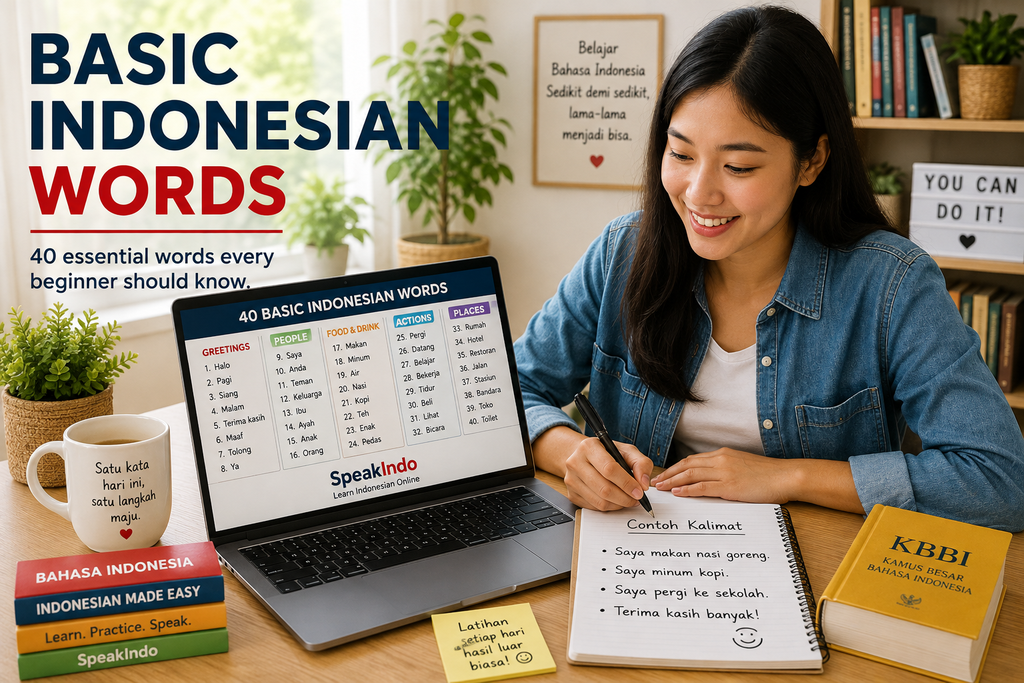
Why Should You Start with Basic Vocabulary?
Imagine learning 500 Indonesian words that you rarely use.
Now compare that with learning 100 words that appear almost every day.
The smaller group may actually be more useful.
For example, words such as makan (eat), minum (drink), pergi (go), and rumah (house) can appear in many everyday conversations.
Therefore, beginners should focus on useful vocabulary first.
In addition, basic words can be combined to create simple sentences. This means you start communicating while your vocabulary is still small.
1. Indonesian Greetings
First, learn several words and expressions that you can use when meeting people.
1. Halo – Hello
2. Pagi – Morning
3. Siang – Afternoon
4. Malam – Evening / night
5. Terima kasih – Thank you
6. Maaf – Sorry / excuse me
7. Tolong – Please / help
8. Ya – Yes
These words are useful in many situations.
For example:
Halo, selamat pagi!
Hello, good morning!
Or:
Terima kasih banyak.
Thank you very much.
At first, keep your sentences short. Later, you can add more words as your confidence grows.
2. Useful Words for Talking About People
After greetings, learn vocabulary for people around you.
9. Saya – I / me
10. Anda – You
11. Teman – Friend
12. Keluarga – Family
13. Ibu – Mother
14. Ayah – Father
15. Anak – Child
16. Orang – Person
Now you can start combining words.
For example:
Ini teman saya.
This is my friend.
Another useful sentence is:
Keluarga saya di rumah.
My family is at home.
Therefore, even a small vocabulary can already help you express simple ideas.
3. Indonesian Words for Food and Drinks
Food is an excellent topic for beginners because you can use these words almost every day.
Start with:
17. Makan – Eat
18. Minum – Drink
19. Air – Water
20. Nasi – Rice
21. Kopi – Coffee
22. Teh – Tea
23. Enak – Delicious
24. Pedas – Spicy
Next, turn them into short sentences.
Saya minum kopi.
I drink coffee.
Saya makan nasi.
I eat rice.
Ini enak.
This is delicious.
These examples are simple. However, they show how vocabulary becomes much more useful when placed inside a sentence.
4. Important Indonesian Verbs
Verbs help you talk about actions.
Therefore, they should become an important part of your vocabulary from the beginning.
Here are eight useful ones:
25. Pergi – Go
26. Datang – Come
27. Belajar – Study / learn
28. Bekerja – Work
29. Tidur – Sleep
30. Beli – Buy
31. Lihat – See / look
32. Bicara – Speak / talk
For example:
Saya belajar Bahasa Indonesia.
I am learning Indonesian.
Saya bekerja hari ini.
I am working today.
Saya mau beli ini.
I want to buy this.
As you can see, one useful verb can become part of many different sentences.
5. Basic Words for Places and Travel
Travellers also need vocabulary for places.
Therefore, add these words to your list:
33. Rumah – House / home
34. Hotel – Hotel
35. Restoran – Restaurant
36. Jalan – Street / road
37. Stasiun – Station
38. Bandara – Airport
39. Toko – Shop
40. Toilet – Toilet
Now imagine that you are travelling in Indonesia.
You could ask:
Di mana stasiun?
Where is the station?
Or:
Di mana toilet?
Where is the toilet?
Suddenly, simple vocabulary has become useful travel language.

Don’t Memorize All 40 Words Today
Seeing forty new words may make you want to learn them all immediately.
However, that is not the best approach.
Instead, choose five or eight words.
First, read them carefully. Next, say each word aloud. After that, create one short sentence with every word.
The following day, review yesterday’s vocabulary before learning something new.
For example, your weekly plan could be:
- Monday: greetings
- Tuesday: people
- Wednesday: food
- Thursday: verbs
- Friday: places
- Weekend: review
This method keeps the amount of new information manageable.
More importantly, review gives your brain another chance to remember older vocabulary.
Learn Words Inside Sentences
A vocabulary list can help you start. However, words become much more useful inside sentences.
Suppose you learn:
kopi – coffee.
Do not stop there.
Try:
Saya minum kopi.
I drink coffee.
Next, add another idea:
Saya minum kopi pagi ini.
I drink coffee this morning.
You have now used one simple word to build a longer message.
Therefore, whenever you learn new vocabulary, try to create at least one sentence with it.
Listen to Indonesian Too
Reading basic Indonesian words is not enough if you want to understand real conversations.
You also need listening practice.
At first, listen to short and clear Indonesian audio. Try to recognise words you have already studied.
For example, you may hear makan or minum inside a sentence.
Recognising even one familiar word is useful.
Next, listen again. You may notice another word during the second attempt.
As a result, listening slowly becomes easier.
In addition, hearing Indonesian regularly can improve your pronunciation.
Say New Words Out Loud
Some students study vocabulary silently.
However, if your goal is speaking, your voice needs practice too.
Say every new word aloud.
Next, repeat the complete sentence. Try to copy the pronunciation that you hear in your lessons.
You can also practise while doing normal activities.
When drinking coffee, say:
Saya minum kopi.
Before leaving home:
Saya pergi.
While studying:
Saya belajar Bahasa Indonesia.
These small habits make Indonesian part of your daily life.
Why Beginners Often Forget Vocabulary
Forgetting words is normal.
The problem usually appears when learners see a word once and never return to it.
Therefore, review is essential.
Imagine learning bandara today. Review it tomorrow, then again several days later.
You can also use the word in different sentences.
For example:
Saya pergi ke bandara.
I go to the airport.
Later, try:
Di mana bandara?
Where is the airport?
Using the same word in different ways helps strengthen your memory.
Don’t Depend Only on Free Word Lists
Free vocabulary lists are useful. In fact, this article gives you forty words without asking you to buy anything.
However, lists alone do not create complete language skills.
You also need to hear Indonesian, understand sentences, practise reading, and start speaking.
In addition, beginners need a clear order.
Without one, it is easy to jump from greetings to difficult grammar and then to another unrelated topic.
As a result, learning can become confusing.
A structured program solves that problem.

Learn Indonesian Step by Step with SpeakIndo
SpeakIndo was created to give beginners a clear learning path.
Instead of searching for new lessons every day, students can focus on actually learning.
The program includes:
- Video lessons
- Indonesian audio
- Everyday vocabulary
- Reading activities
- Speaking practice
- Exercises
- Quizzes
- Flexible online study
First, a lesson introduces new language. Next, students hear Indonesian through audio. After that, exercises help them practise.
Finally, speaking activities encourage learners to use their new knowledge.
Therefore, vocabulary does not remain a collection of separate words.
It becomes part of your Indonesian communication skills.
Learn at Your Own Pace
Everyone learns differently.
For example, you may remember food vocabulary quickly but need more time with verbs. Another student might find listening easy while struggling to remember new words.
Online learning gives you more control.
Repeat a difficult lesson when necessary. Meanwhile, move forward when a topic feels comfortable.
There is no need to rush.
Regular progress is more important than finishing the course as quickly as possible.
Who Should Learn Basic Indonesian?
Many different people can benefit from learning Indonesian.
Travellers can use basic words in restaurants, hotels, shops, and transport. Meanwhile, expats often need Indonesian for daily life.
International students may want to communicate with local people. In addition, professionals can use Indonesian with colleagues or clients.
Personal reasons are important too.
Perhaps your partner is Indonesian. Maybe you have Indonesian friends or family members.
In that case, learning their language can create new ways to communicate.
Continue Learning with SpeakIndo
These basic Indonesian words are only your starting point.
Once you know them, continue with related SpeakIndo guides.
Add actual internal links to:
- Indonesian Phrases for Beginners
- Indonesian Vocabulary for Beginners
- Indonesian Conversation for Beginners
- How to Learn Indonesian
- Learn Indonesian Online
- Basic Indonesian Course
For example, readers who finish this vocabulary article can continue with Indonesian Phrases for Beginners to see how words work inside useful expressions.
After that, Indonesian Conversation for Beginners can help them move toward longer exchanges.
This creates a natural learning path across your blog.
For official Indonesian word meanings and spelling, learners can also use KBBI, the official Indonesian dictionary.
Start Learning Basic Indonesian Words Today
You now have 40 words that can help you talk about greetings, people, food, actions, places, and everyday life.
However, do not simply read the list and close the page.
Choose five words.
First, say them aloud. Next, create a short sentence with each one. Finally, review those words tomorrow before adding something new.
Once you are ready for more, SpeakIndo can guide you through a complete learning path.
Video, audio, vocabulary, reading, exercises, quizzes, and speaking activities work together to help beginners develop practical Indonesian skills.
Visit SpeakIndo and start learning Indonesian today.
Finally, know someone who is planning a trip to Indonesia or wants to learn the language? Share this article with them. Challenge each other to learn ten of these words this week and use them in your first Indonesian sentences.