
Starting to learn Indonesian can be exciting. You discover new words, begin recognising familiar expressions, and imagine yourself communicating confidently in Indonesia.
Then life gets busy.
A few missed study days become a week. Eventually, you realise you have barely studied for a month.
If you are wondering how to learn Indonesian consistently, the answer is not simply to study harder. Instead, you need a learning routine that is realistic enough to continue.
SpeakIndo makes this easier by providing a structured e-learning program with video lessons, Indonesian audio, vocabulary, reading, speaking activities, exercises, and quizzes. Rather than searching for something new every time you study, you can simply continue your learning journey.

Why Beginners Often Stop Learning Indonesian
Most people do not stop because they suddenly dislike the language.
Usually, something else happens.
Some learners create an unrealistic schedule. They decide to study for one or two hours every day. Although that sounds productive, maintaining such a routine alongside work and family life can be difficult.
Others have the opposite problem.
They do not have a learning plan at all.
One day they watch an Indonesian video. Later, they download an app. Afterwards, they find a vocabulary list on another website.
There is plenty of activity but little direction.
Consequently, progress becomes difficult to see.
Once motivation disappears, studying often disappears with it.
Don’t Depend Only on Motivation
Motivation is wonderful when it appears.
Unfortunately, it is unreliable.
You may feel extremely motivated on Monday and have no desire to study by Thursday.
Therefore, successful language learning should not depend entirely on how motivated you feel that day.
A routine provides more stability.
Instead of asking yourself, “Do I feel like studying Indonesian today?” create specific moments when learning becomes part of your normal week.
That small change can make a big difference.
Start with a Realistic Study Goal
Beginners sometimes believe that more study automatically means faster progress.
However, an ambitious schedule is useless if you cannot maintain it.
Suppose you plan to study Indonesian for two hours every evening. During the first week, everything goes well.
Then work becomes busy.
You miss Tuesday. Wednesday is difficult too. By Friday, the original schedule already feels impossible.
A smaller goal may work better.
For example, several focused study sessions throughout the week can be easier to maintain than forcing yourself to study for hours every day.
Consistency matters.
Your Indonesian develops through repeated contact with the language, not through one enormous study session.
Follow a Learning Path
Knowing what to study next removes an important obstacle.
Imagine sitting down at your laptop with thirty minutes available.
If you first need to search YouTube, compare websites, choose a podcast, and decide which vocabulary to learn, part of your study time has already disappeared.
A structured course changes that.
You open your course and continue.
SpeakIndo provides a learning path in which different activities support your development. Video lessons introduce material, while audio helps you become familiar with spoken Indonesian.
Meanwhile, reading, speaking, exercises, and quizzes give you opportunities to work actively with what you have learned.
You spend less time organising your education and more time actually studying.
Combine Different Learning Activities
Doing exactly the same thing every day can become boring.
Therefore, vary your learning activities.
One study session might focus on a video lesson. During another, concentrate on Indonesian audio.
Later in the week, review vocabulary or complete exercises.
Reading gives you another way to interact with the language, whereas speaking activities encourage you to produce Indonesian yourself.
Variety keeps your routine more interesting.
At the same time, you develop several language skills instead of concentrating on only one.
Don’t Rush Through Video Lessons
Completing lessons can feel rewarding.
You see yourself moving through the course and naturally want to continue.
However, finishing a video is not the same as mastering its content.
Take time to process what you learn.
If necessary, pause the lesson. Review unfamiliar vocabulary before moving forward.
Later, return to material that was difficult.
Your goal is not to finish an Indonesian course as quickly as possible.
The real goal is to develop skills that you can remember and eventually use.
Review What You Already Learned
New material often feels more exciting than old material.
Nevertheless, review is essential.
Without repetition, vocabulary that seemed easy last month may slowly disappear from memory.
Fortunately, reviewing does not need to mean repeating an entire lesson from beginning to end.
Spend a short session revisiting vocabulary. Replay an audio activity or return to an exercise that you previously found difficult.
You might be surprised by the result.
Something that felt difficult several weeks ago may suddenly seem much easier.
That is progress.
Make Listening a Regular Habit
Listening is one of the skills that benefits greatly from regular exposure.
At first, Indonesian may sound fast.
You might recognise individual words but struggle to follow the complete message.
Keep listening.
Gradually, your brain becomes more familiar with pronunciation and rhythm.
Instead of expecting immediate understanding, notice smaller improvements.
Perhaps you recognise more words than last week. Maybe you understand part of an audio recording without looking at the lesson.
These improvements may seem small, but together they show that your listening skills are developing.

Practise Speaking Before You Feel Ready
Some students spend months studying silently.
They read vocabulary, watch videos, and complete exercises. However, they keep postponing speaking practice.
“I’ll speak when my Indonesian is better.”
The problem is that speaking itself is a skill.
You cannot fully develop it without practising.
Start with what you already know.
Repeat language from your lessons aloud. Use speaking activities and try answering without immediately looking at your notes.
You will make mistakes.
That is expected.
Over time, words that once required a lot of thought can become easier to recall.
What If You Miss a Week?
Missing several study sessions does not mean you have failed.
Life changes.
You may travel, become busy at work, or simply have a difficult week.
The important part is what happens next.
Do not create a complicated plan to compensate for every missed session. Instead, return to your normal routine.
Review a little if necessary and continue.
This approach is much easier than deciding that you need to “start again” every time you take a break.
Consistency does not mean never missing a day.
It means repeatedly returning to your learning.
Stop Comparing Yourself with Other Learners
Someone else may learn vocabulary faster than you.
Another student might feel comfortable speaking after only a short time.
That does not mean your learning is going badly.
People have different backgrounds, schedules, previous language experience, and learning preferences.
Therefore, compare your current abilities with your earlier abilities instead.
Can you understand more than you could a month ago?
Do familiar words appear more quickly when listening?
Can you remember vocabulary that once felt difficult?
Those changes matter.
Make Your Indonesian Relevant to Your Life
Learning becomes easier to maintain when the language has a purpose.
Perhaps you are planning a trip to Indonesia.
Maybe your partner is Indonesian. You could be moving to Jakarta, Bali, Bandung, Surabaya, or another part of the country.
Professional reasons can provide motivation too.
Whatever your reason, connect your study to it.
When Indonesian becomes something you expect to use rather than simply another subject to study, regular practice can feel more meaningful.
Use E-Learning to Fit Around Your Schedule
Traditional lessons happen at specific times.
E-learning offers more freedom.
You can study in the morning, during a quiet afternoon, or later in the evening.
A busy week may allow only short sessions. When you have more time, you can study longer.
Furthermore, you can repeat difficult material instead of being forced to move at the same speed as an entire class.
This flexibility is particularly useful for learners who struggle to maintain a fixed schedule.
Your learning can adapt to your life rather than requiring your life to adapt completely to your lessons.
How SpeakIndo Helps You Stay on Track
SpeakIndo brings your main Indonesian learning activities together in one place.
Video lessons provide structure. Indonesian audio supports listening development, while vocabulary gives you important building blocks.
Reading activities strengthen comprehension.
Meanwhile, speaking activities encourage you to actively use Indonesian.
Exercises provide practice, and quizzes allow you to check your understanding.
Because the course follows a learning path, you do not have to build your entire Indonesian program yourself.
Open the course, continue your lesson, and keep moving forward.
That simplicity can make regular learning easier.
A Simple Weekly Indonesian Routine
You do not need an elaborate timetable.
For example, begin one session with a video lesson and vocabulary. During your next study period, concentrate on listening and review.
Later, work on reading, speaking, or exercises.
At the end of the week, a quiz can help you check what you understand.
Then continue.
The exact schedule matters less than whether it fits your life.
If three shorter sessions are realistic, start there.
You can always study more when you have extra time.
Use Free Resources as Extra Practice
A structured e-learning course can remain your main learning path while free resources provide additional practice.
For example, if listening is difficult, connect this article to your existing Indonesian Listening Practice and Understand Spoken Indonesian articles.
Readers who want to improve pronunciation can continue with Indonesian Pronunciation for Beginners.
You can also internally link Learn Indonesian for Everyday Conversations and Learn Indonesian at Your Own Pace.
These internal links help visitors explore related SpeakIndo content instead of leaving after reading one article.
For official Indonesian spelling and definitions, learners can also use KBBI, the official Indonesian dictionary.
Small Steps Can Create Real Progress
You do not need to transform your entire daily routine to learn another language.
Start smaller.
Study regularly. Review earlier material and practise different skills.
When life becomes busy, adjust your schedule rather than giving up completely.
Most importantly, stop waiting for the perfect moment to study.
Understanding how to learn Indonesian consistently is largely about creating a learning system that you can continue even when your motivation changes.
SpeakIndo gives beginners a structured e-learning path with video, Indonesian audio, vocabulary, reading, speaking activities, exercises, and quizzes.
You decide when to study.
Then you keep taking the next step.
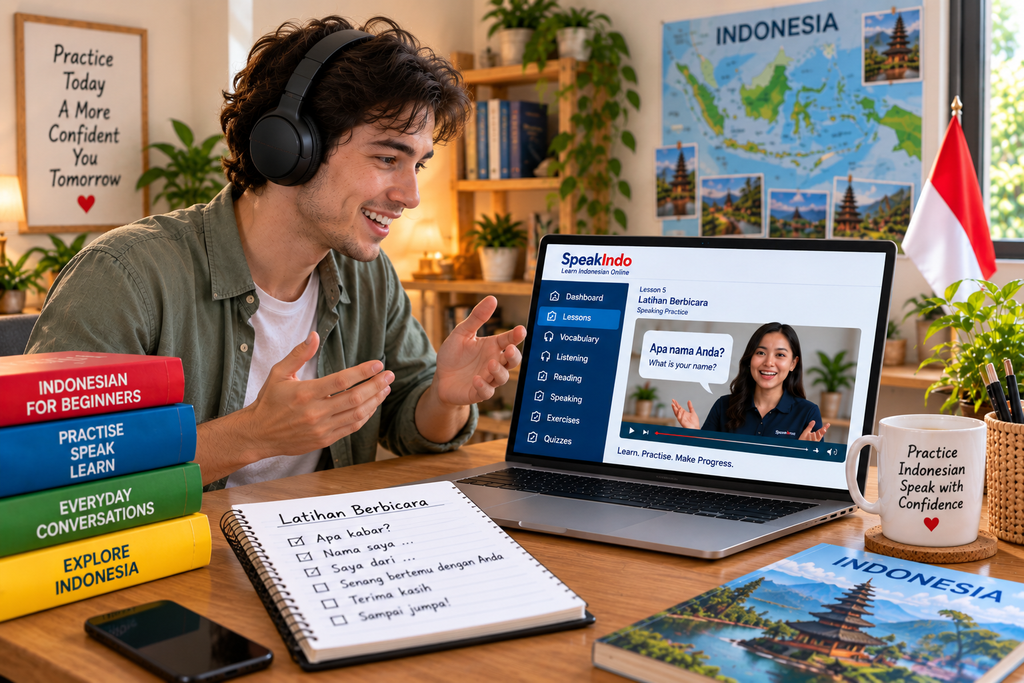
Start Learning Indonesian with SpeakIndo
Ready to turn Indonesian into part of your regular routine?
With SpeakIndo, you can follow a structured online program instead of spending your time searching for disconnected lessons.
Start learning Indonesian with SpeakIndo
You don’t have to learn everything today. You only need to keep learning.
If you know someone who keeps starting and stopping their Indonesian studies, share this article with them. Better still, learn together and help each other stay consistent.