
You study Indonesian vocabulary. You recognise words when you see them. Perhaps you can even complete exercises without much difficulty. Then, someone starts speaking Indonesian and suddenly everything sounds much harder.
This experience is common among beginners.
Learning to understand spoken Indonesian requires a different type of practice from simply memorising words. Your brain needs time to connect familiar vocabulary with the sounds you hear during conversations.
Fortunately, you can train this skill.
With regular listening, repetition, video lessons, and active practice, spoken Indonesian can gradually become easier to follow. SpeakIndo combines these activities in one structured e-learning program so beginners can develop their skills step by step.

Why Spoken Indonesian Can Sound So Fast
When you read Indonesian, you control the speed.
A difficult sentence can be read twice. You can stop at an unfamiliar word or think about its meaning before continuing.
Listening works differently.
The speaker continues while your brain is still processing the previous words. Consequently, you may recognise individual words without understanding the complete message.
Beginners often assume that Indonesian speakers are talking extremely quickly.
However, another problem is usually involved: your brain has not yet learned to recognise familiar Indonesian words automatically.
That ability develops through repeated exposure.
Knowing a Word Is Not the Same as Hearing It
Imagine learning twenty new Indonesian words from a vocabulary list.
After studying them several times, you can recognise almost every word on the page.
Excellent.
Nevertheless, hearing those same words can still be difficult.
Written language provides visual information. Listening requires you to recognise pronunciation, rhythm, and sounds immediately.
Therefore, vocabulary study and listening practice should work together.
When you learn new vocabulary, try to hear it as well as read it. Gradually, your brain begins connecting the written form with the spoken language.
Listen Regularly Instead of Occasionally
One long listening session every two weeks is unlikely to be as useful as regular exposure.
Instead, make Indonesian listening part of your weekly routine.
You could spend a short study session listening to course audio. On another day, watch a video lesson and pay close attention to pronunciation.
Later, return to the same material.
Repetition matters because you do not need completely new content every time you study.
In fact, familiar audio can be extremely useful.
During the first listen, you may understand only the general topic. The second time, several familiar words become clearer. Afterwards, you may notice details that you missed earlier.
Small improvements like these can build stronger listening skills over time.
Stop Trying to Understand Every Word
Beginners often make one important mistake.
They try to understand everything.
As soon as one unfamiliar word appears, their attention moves completely toward that word. Meanwhile, the speaker continues talking.
Now several more words have been missed.
Instead, practise listening for information you do recognise.
What is the general topic? Which words sound familiar? Can you understand the main idea even though several details remain unclear?
This approach can make listening less frustrating.
Furthermore, real conversations do not require perfect understanding of every individual word.
Use Video and Audio Together
Video can be especially useful during the beginner stage.
Visual information provides additional context while you listen. Facial expressions, images, and lesson explanations can all support understanding.
SpeakIndo uses video lessons to introduce learning material in a structured way.
However, watching should not become completely passive.
Pay attention to how Indonesian sounds. Pause when necessary and repeat difficult sections.
Later, use audio practice without depending as much on visual information.
This combination can gradually strengthen your ability to understand spoken language.
Repeat What You Hear
Listening does not have to be silent.
When you hear Indonesian during a lesson, try repeating some of the words or phrases aloud.
This gives you another way to interact with the language.
Your ears hear the pronunciation, while your mouth practises producing similar sounds.
At first, this may feel unfamiliar.
Nevertheless, regular repetition can help you become more aware of pronunciation.
Speaking practice also forces you to pay closer attention to what you hear.
Instead of simply letting the audio play, you begin noticing individual sounds more carefully.
Build Your Vocabulary Gradually
Listening becomes difficult when almost every word is unfamiliar.
For this reason, vocabulary still matters.
However, you do not need to memorise thousands of words before beginning listening practice.
Build your vocabulary gradually while continuing to listen.
New words from one lesson may appear again later. Each encounter strengthens your familiarity with them.
Reading can also support this process.
When you meet the same vocabulary through reading, video, audio, and exercises, you interact with it in different ways.
Consequently, the words have more opportunities to become familiar.

Don’t Jump Between Too Many Resources
YouTube, social media, podcasts, apps, and websites provide enormous amounts of Indonesian content.
That sounds helpful.
Yet beginners can easily become overwhelmed.
Today you watch a beginner video. Tomorrow you find an advanced podcast. Afterwards, an app introduces completely different vocabulary.
There is little connection between the materials.
A structured course solves this problem by giving your learning a clear direction.
You can still use free resources. However, they work better as additional practice rather than becoming a collection of unrelated lessons.
How SpeakIndo Helps Beginners
SpeakIndo was created to give learners a more structured way to study Indonesian online.
Video lessons introduce new material. Indonesian audio gives you opportunities to develop listening skills.
Meanwhile, vocabulary activities help expand the words you recognise.
Reading develops another side of comprehension, whereas speaking activities encourage you to actively use Indonesian.
Exercises provide further practice.
Finally, quizzes allow you to check your understanding before continuing.
These activities support each other.
Instead of treating listening as a completely separate skill, you develop it alongside other areas of Indonesian.
Use Your Own Pace to Your Advantage
One benefit of e-learning is that nobody forces you to continue before you are ready.
Did you find an audio exercise difficult?
Listen again.
Was a video lesson easy to understand?
Continue to the next activity.
Perhaps you need additional time with vocabulary this week. Spend more time reviewing it.
Your learning pace does not need to match another student’s pace.
This flexibility is particularly useful for listening because repeated exposure is often necessary.
Instead of thinking, “I already listened to this,” ask yourself whether you understand it better than before.
That is a much more useful measure of progress.
Try a Simple Weekly Listening Routine
You do not need to listen to Indonesian for hours every day.
A realistic routine is more useful.
Start the week with a video lesson. During your next study session, concentrate on the related vocabulary and audio.
Later, listen again without immediately checking the material.
Towards the end of the week, combine listening with exercises, reading, or speaking practice.
This approach gives you repeated contact with the same language without doing exactly the same activity every day.
Most importantly, keep your routine manageable.
Consistency usually matters more than one enormous study session followed by several weeks without practice.
Prepare Your Ears for Real Life in Indonesia
Listening skills become particularly valuable when you visit or live in Indonesia.
You may hear Indonesian while ordering food, travelling, shopping, or speaking with local people.
At first, real conversations can still sound faster than course material.
That is normal.
However, regular listening practice gives you a stronger foundation.
You may begin recognising familiar vocabulary in conversations around you. Later, longer parts of the conversation can become understandable.
Those moments can be motivating because your study begins connecting with real life.
Combine Listening with Speaking
Listening and speaking support each other.
When you listen carefully, you become more aware of pronunciation and rhythm.
Meanwhile, speaking makes you think about how Indonesian words actually sound.
Therefore, avoid spending all your study time silently reading.
Use speaking activities when possible.
Repeat words aloud. Practise answering questions from your course. Try using recently learned vocabulary without looking at your notes.
You do not need perfect pronunciation before you start.
Practice comes first.
Confidence usually develops afterwards.
Who Can Benefit from Better Indonesian Listening?
Travellers can benefit because listening helps during everyday interactions in Indonesia.
Expats may need the skill even more frequently. Conversations with neighbours, colleagues, drivers, shopkeepers, and other local people can become part of daily life.
Meanwhile, people with Indonesian partners or family members may want to understand more of the conversations happening around them.
Professionals can also benefit when communicating with Indonesian colleagues or customers.
Whatever your reason for learning, understanding spoken language can make Indonesian much more useful outside your study materials.
Use Additional Resources Wisely
Your main learning program can work alongside other reliable resources.
For pronunciation practice, connect this article internally to your existing Indonesian Pronunciation for Beginners article.
You can also link to Indonesian Listening Practice, Learn Indonesian for Everyday Conversations, and Study Indonesian Online for Beginners.
These internal links help readers continue learning while also connecting related SpeakIndo content.
When you need to check an Indonesian word or spelling, you can also use KBBI, the official Indonesian dictionary.
Start Understanding More Indonesian
You will probably not wake up one morning and suddenly understand every Indonesian conversation.
Progress happens gradually.
First, you recognise a few words. Later, you begin understanding short parts of conversations. With more exposure, familiar language becomes easier to process.
That is why regular practice matters.
To understand spoken Indonesian, combine listening with vocabulary, reading, speaking, and active exercises instead of relying on one learning method.
SpeakIndo brings these activities together in a structured online program designed to help beginners continue learning step by step.
You can study when it suits you, repeat difficult material, and return to previous lessons whenever necessary.
Most importantly, you can stop spending your study time wondering what to learn next.
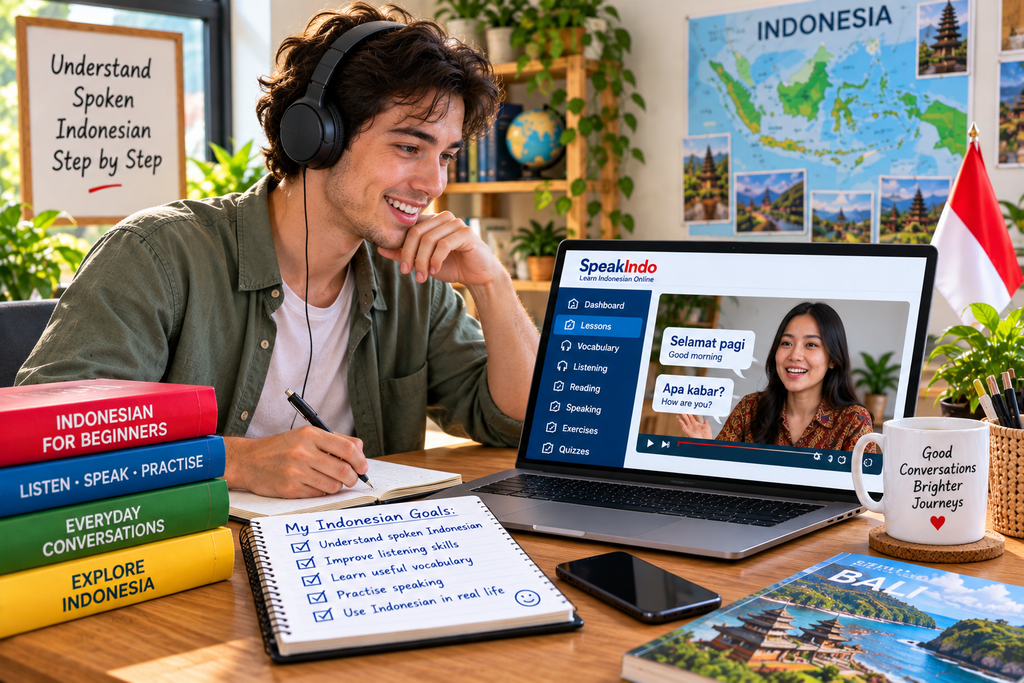
Start Learning with SpeakIndo
Ready to improve your Indonesian?
SpeakIndo gives you video lessons, Indonesian audio, vocabulary practice, reading, speaking activities, exercises, and quizzes in one online learning program.
Start learning Indonesian with SpeakIndo
Know someone who understands Indonesian on paper but struggles when people start talking? Share this article with them. You can even practise listening and speaking together.