
Starting Indonesian Does Not Have to Be Difficult
Learning the Indonesian language for beginners can feel exciting at first. However, many new learners quickly discover another problem: they do not know where to begin. Should you study vocabulary first? Do you need grammar? How much time should you spend listening? Most importantly, when should you start speaking?
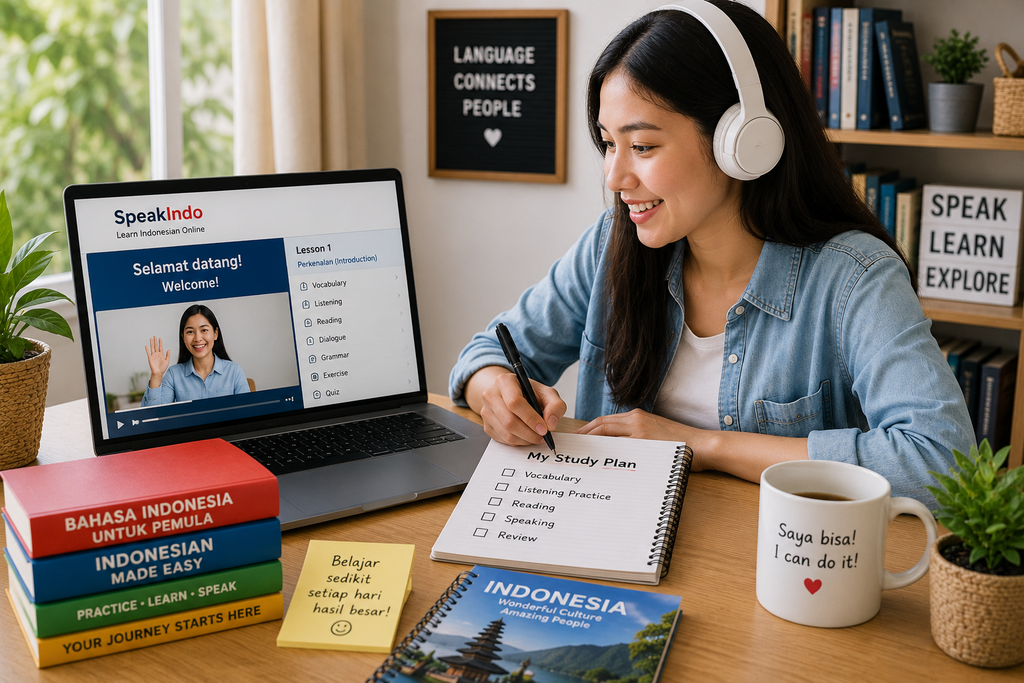
Fortunately, learning Indonesian does not need to be complicated. A clear plan can help you build your skills one step at a time. First, focus on useful everyday vocabulary. Next, train your ears through regular listening. After that, begin using what you learn through speaking and other activities. SpeakIndo follows this practical approach. Instead of giving beginners random material, the program brings video, audio, vocabulary, reading, exercises, and speaking together in a clear learning path.
Is Indonesian Good for Beginners?
Indonesian has several features that may encourage new learners.
For example, the writing system uses the Latin alphabet. Therefore, English speakers do not need to learn a completely new writing system before they can start reading.
Indonesian grammar also works differently from many European languages. However, beginners should not assume that this means no study is required.
You still need vocabulary. In addition, understanding spoken Indonesian takes practice. Pronunciation, word order, and natural communication also develop over time.
Therefore, it is better to think of Indonesian as an accessible language rather than an effortless one.
With regular practice, beginners can start making useful progress without studying difficult material immediately.
Why Beginners Often Lose Motivation
Starting a language is usually exciting.
During the first week, you may download several apps, watch videos, save vocabulary pages, and follow Indonesian learning accounts on social media.
However, that excitement does not always last.
After a while, you may have too many resources. One video teaches greetings, while another explains advanced grammar. Meanwhile, an app introduces vocabulary that has nothing to do with what you studied yesterday.
As a result, learning starts to feel messy.
The problem is not always motivation.
Sometimes the real problem is the lack of a clear path.
When you know what to learn next, it becomes much easier to continue.
Start with Everyday Indonesian
Beginners should not try to learn every part of the language at once.
Instead, begin with topics that connect to daily life.
Useful starting areas include:
- Greetings
- Introductions
- Family
- Numbers
- Food and drinks
- Shopping
- Time and dates
- Transport
- Work
- Daily activities
These topics give your learning a practical purpose.
For example, numbers become useful when shopping. Meanwhile, food vocabulary prepares you for restaurants and everyday conversations.
Therefore, every new topic can support something you may actually want to do in Indonesian.
Vocabulary Is Important, but Don’t Learn Random Words
A large vocabulary is useful. However, beginners often focus too much on the number of words they know.
Knowing 1,000 random words does not guarantee that you can communicate.
Instead, focus on useful groups of vocabulary.
For example, learn food words together. Later, move to transport or family. Grouping vocabulary creates connections between related words.
In addition, review older material regularly.
Learning ten words and remembering them is better than learning fifty and forgetting most of them.
Therefore, do not measure progress only by how much new material you complete.
Remembering and using earlier material matters too.
Listening Should Start Early
Many beginners feel more comfortable reading than listening.
Written words stay on the screen. Therefore, you have time to think about their meaning.
Spoken language is different.
Words arrive quickly, and you cannot always pause a real conversation.
For this reason, listening should become part of your routine from the beginning.
Start with clear material created for learners. First, listen for words you recognise. Next, focus on the main idea.
There is no need to understand everything.
As your ears become familiar with Indonesian, listening gradually becomes easier. In addition, regular audio can support better pronunciation.

Don’t Wait Too Long Before Speaking
Speaking can feel uncomfortable for new learners.
Some people wait because they want more vocabulary. Others believe they need perfect grammar first.
However, waiting too long can become a habit.
You do not need to know everything before using Indonesian.
Instead, start with the material you already understand. Practise aloud, repeat useful language, and become comfortable hearing your own voice in Indonesian.
Mistakes will happen.
That is normal.
More importantly, speaking practice helps move language from passive knowledge into active communication.
Why Grammar Should Not Be Your Only Focus
Grammar helps you understand how a language works.
Therefore, it should be part of your learning.
However, studying grammar alone can create a problem. You may understand rules on paper while still struggling during a simple conversation.
A balanced approach works better.
Learn enough grammar to understand useful patterns. At the same time, continue building vocabulary, listening, reading, and speaking skills.
This gives grammar a practical purpose.
Instead of trying to memorise every rule, you gradually understand how the language works through use.
For beginners, this approach can also make studying feel less stressful.
Create a Routine That Fits Your Life
You do not need to study Indonesian for hours every day.
In fact, shorter sessions are often easier to continue.
For example, you could spend a little time on vocabulary one day and focus on listening the next. Later in the week, review earlier lessons.
A simple routine may include:
- Short video lessons
- Vocabulary review
- Listening activities
- Reading practice
- Speaking aloud
- Weekly review
The exact schedule is less important than consistency.
Therefore, choose a routine that fits your normal life.
If twenty minutes feels realistic, start there.
Regular learning is more useful than creating an ambitious plan that you stop following after two weeks.
Why Online Learning Works for Beginners
Online learning gives students more control over their study schedule.
For example, busy professionals can study after work. Meanwhile, students may prefer learning between classes.
You can also repeat material whenever necessary.
If a listening activity feels difficult, play it again. When vocabulary has been forgotten, return to an earlier lesson.
Therefore, you do not need to move forward simply because another student is ready.
This flexibility can be especially useful at beginner level.
However, flexibility works best when it comes with structure.
Having unlimited learning resources is not useful if you still do not know what to study next.
Why Self-Study Sometimes Stops Working
There is nothing wrong with learning independently.
In fact, motivated students can make excellent progress through self-study.
However, random self-study often creates problems.
A learner may spend hours searching for materials instead of actually studying. In addition, it can be difficult to know whether one topic is too easy or too advanced.
Eventually, progress becomes harder to measure.
A structured course removes part of that uncertainty.
Instead of choosing a completely new topic every day, you follow a learning path where earlier lessons support later ones.
Therefore, your time can be spent learning rather than planning every study session from the beginning.
How SpeakIndo Helps Beginners
SpeakIndo was designed to make Indonesian learning clearer for new students.
The goal is not to fill every lesson with difficult information. Instead, learners develop useful skills gradually.
The program includes:
- Video lessons
- Indonesian audio
- Everyday vocabulary
- Reading activities
- Listening practice
- Speaking activities
- Exercises
- Quizzes
- Flexible online access
Each activity has a purpose.
First, students discover new material. Next, they hear and practise it. Exercises then help strengthen earlier learning.
Most importantly, the program gives beginners a direction.
You know where you are starting and what comes next.
Learn Indonesian for Your Own Goal
People choose Indonesian for different reasons.
Travellers may want more confidence during a holiday. Meanwhile, expats often need Indonesian for everyday life.
International students may want to connect with local people. Professionals can also benefit when working with Indonesian colleagues or customers.
For others, the reason is personal.
Perhaps your partner is Indonesian. Maybe you have friends or family in the country.
Your reason matters because it can guide your learning.
Therefore, think about what you actually want to do with Indonesian.
A clear goal makes it easier to choose useful topics and stay motivated.
Measure Progress by What You Can Do
Finishing lessons can feel satisfying. However, the number of completed lessons is not the only sign of progress.
Instead, notice what has become easier.
Perhaps you recognise more words when listening. Maybe reading a short text takes less time than before.
Later, you may feel more comfortable speaking.
These small improvements matter.
Therefore, do not compare your progress with someone else’s.
One learner may develop listening quickly, while another remembers vocabulary more easily.
Focus on your own improvement.
Continue Learning with SpeakIndo
If you are exploring the Indonesian language for beginners, you can continue with other SpeakIndo guides.
Add internal links in WordPress to:
- How to Learn Indonesian
- Basic Indonesian Words
- Indonesian Phrases for Beginners
- Indonesian Conversation for Beginners
- Learn Indonesian for Travel
- Learn Indonesian Online
This creates a useful path through your website.
For example, a new learner can start here and continue to Basic Indonesian Words. Next, they can explore Indonesian Phrases for Beginners before moving toward conversation practice.
As a result, readers can find the next useful article without returning to Google.
For official Indonesian spelling and word meanings, learners can also use KBBI, the official Indonesian dictionary.

Start Learning Indonesian Today
The most important part of learning a language is starting.
You do not need hundreds of words, advanced grammar, or hours of free time.
Instead, begin with useful topics. Study regularly, listen often, review what you learn, and gradually add speaking practice.
SpeakIndo provides a clear program for the Indonesian language for beginners. Video lessons, audio, vocabulary, reading, exercises, quizzes, and speaking activities work together to help you move forward step by step.
Most importantly, you can learn at your own pace.
Visit SpeakIndo and discover the online Indonesian program for beginners.
Start today. Build your skills one step at a time and turn Indonesian from something you study into a language you can actually use.
Finally, do you know someone who also wants to learn Indonesian? Share this guide with them and start learning together. Having a learning partner can make practice more enjoyable and give both of you another reason to continue.