
Start with the Right Learning Method
If you are wondering how to learn Indonesian, the good news is that you do not need to master complicated grammar before having your first conversation. Indonesian can be approached step by step, starting with useful words and phrases that appear in everyday life.
The bigger challenge is choosing the right learning method. Beginners often download several apps, watch random videos, save vocabulary lists, and read grammar pages. After a few weeks, they have collected plenty of information but still struggle to speak.
A clear learning path can make a major difference. Start with basic vocabulary, listen to the language regularly, practise short sentences, and gradually move toward real conversations. SpeakIndo follows this practical approach by bringing these skills together in one online learning program.
Is Indonesian Difficult to Learn?
Every new language requires practice, but Indonesian has several features that beginners may find encouraging.
For example, Indonesian verbs do not change in the same way as many English or European verbs. You also do not have grammatical gender for nouns like you find in languages such as French or German.
Pronunciation can become familiar with regular listening practice.
However, simple grammar does not mean that you can become fluent without effort.
Vocabulary still needs to be learned. Your ears need time to become familiar with spoken Indonesian, and speaking confidently requires regular use.
The goal should therefore be steady progress rather than instant fluency.
Step 1: Learn Useful Words First
You do not need thousands of words before you start communicating.
Begin with vocabulary that appears in everyday situations.
Useful topics include:
- Greetings
- Numbers and prices
- Food and drinks
- Family
- Time and dates
- Shopping
- Transport
- Work
- Daily activities
Suppose you are travelling through Indonesia. Words connected to restaurants, transport, money, and greetings will probably help you much more than advanced vocabulary.
Context also makes words easier to remember.
Instead of learning makan only as “eat,” place it inside a sentence:
Saya mau makan.
I want to eat.
Now you have something you can actually use.
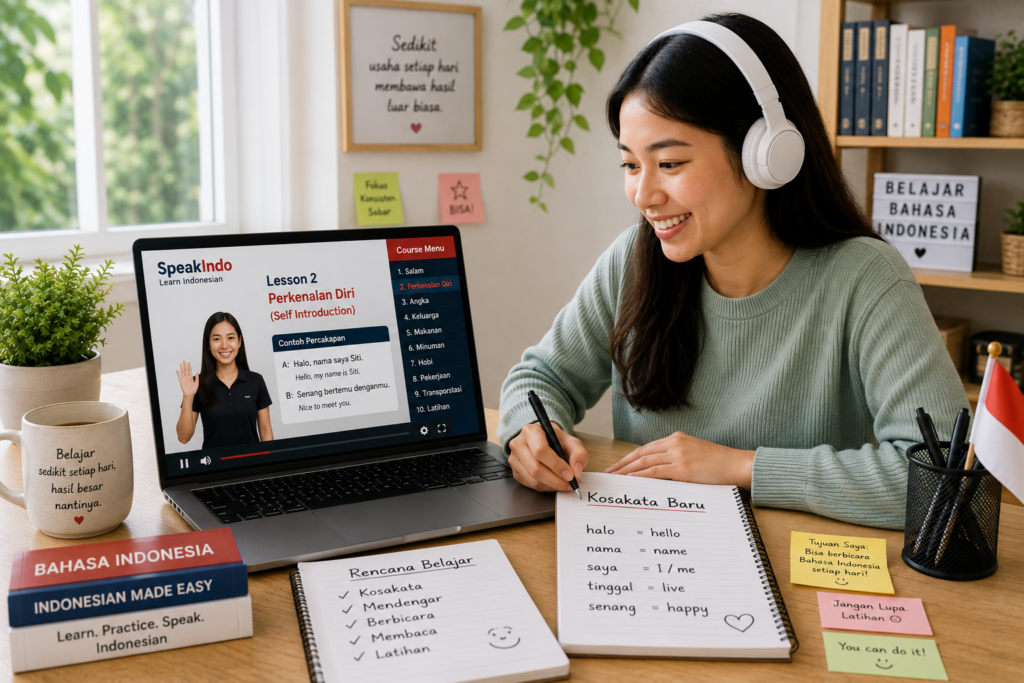
Step 2: Listen to Indonesian Every Day
Listening should begin early.
Many students spend most of their time reading because written language feels easier. Then, when an Indonesian person speaks to them, familiar words suddenly become difficult to recognise.
Regular audio practice helps close that gap.
Start with short recordings made for beginners. Listen once without stopping. During the second attempt, focus on words you recognise.
You do not have to understand every sentence.
As your ears become familiar with Indonesian sounds, comprehension gradually improves. Listening also helps pronunciation because you repeatedly hear how words should sound.
Even ten minutes a day can be useful.
Step 3: Speak Before You Feel Ready
One of the biggest mistakes beginners make is waiting too long before speaking.
They tell themselves:
“I need more vocabulary first.”
Or:
“I’ll start speaking when my grammar is better.”
Unfortunately, that perfect moment rarely arrives.
Use the Indonesian you already know.
Start with:
Halo! Apa kabar?
Hello! How are you?
Then introduce yourself:
Nama saya John.
My name is John.
Add information gradually:
Saya dari Australia.
I am from Australia.
You have already created a small conversation with only a few phrases.
Speaking improves through speaking.
Step 4: Learn Indonesian Through Real Situations
Vocabulary becomes much more useful when it is connected to daily life.
Imagine entering a restaurant.
You could learn words for food, drinks, numbers, prices, and polite requests within the same topic. Later, those words can be practised in a short restaurant conversation.
Another lesson might focus on transport.
Instead of memorising unrelated words, you learn expressions that help you ask where something is, understand basic directions, or communicate with a driver.
This is one reason SpeakIndo focuses on practical situations.
Learners should be able to see how the language they study can be used outside the course.
Step 5: Combine Different Language Skills
Watching videos alone will not make you a confident speaker.
Neither will memorising vocabulary.
A better approach combines several skills.
SpeakIndo therefore includes:
- Video lessons
- Indonesian audio
- Everyday vocabulary
- Reading practice
- Speaking activities
- Exercises
- Lesson quizzes
- Flexible online study
Each part serves a different purpose.
Video can explain a new topic. Audio trains your listening, while reading helps you recognise words in context. Speaking practice then encourages you to use your knowledge actively.
Together, these activities create a more complete learning experience.
Ready to learn Indonesian step by step?
Get structured video lessons, listening practice, exercises and quizzes with SpeakIndo.
Step 6: Study Less but More Often
You do not need two hours every day.
In fact, shorter sessions may be easier to maintain.
Imagine two students.
The first studies Indonesian for three hours every Sunday. The second spends twenty minutes studying five days a week.
After several months, the second learner has had much more regular contact with the language.
A simple routine could look like this:
Monday: vocabulary
Tuesday: listening
Wednesday: video lesson
Thursday: speaking
Friday: review
Weekends can be used for extra practice or rest.
The exact schedule is not important. Consistency matters more.
Step 7: Stop Translating Everything
Translation is useful at the beginning, but depending on it forever can slow down conversations.
Try connecting simple Indonesian words directly with their meaning.
When you see water, think:
air
When you eat, remember:
makan
When you leave home:
pergi
These small mental exercises help Indonesian become more automatic.
Eventually, you want to understand a simple Indonesian sentence without translating every word into English first.
That change takes time, so do not rush it.
Step 8: Accept Your Mistakes
Nobody learns another language without making mistakes.
Pronunciation may be imperfect. A word can disappear from your memory halfway through a sentence, or you may choose the wrong expression.
Keep going.
Successful communication matters more than perfect Indonesian at beginner level.
Mistakes can actually help you improve. When you notice one, review the correct form and try using it again.
Confidence grows when you stop treating every conversation like an exam.
How to Learn Indonesian When You Are Busy
A lack of time is one of the most common reasons people stop studying.
Fortunately, online learning makes it easier to fit Indonesian around your schedule.
Use small moments.
Listen to Indonesian while having breakfast. Review vocabulary during a coffee break. Complete a short lesson after work.
Travellers can study from a hotel, while busy professionals can learn from home.
Your learning environment does not need to be perfect.
You simply need a routine you can continue.

Why a Structured Course Can Help
Free resources are useful, and you should not stop using them.
The problem is structure.
Searching YouTube every time you want to study creates another decision: what should you learn next?
A structured course removes that question.
SpeakIndo gives beginners a learning path where lessons build on earlier material. Instead of collecting disconnected information, you can focus on developing your skills.
This approach is especially useful for learners who have tried studying Indonesian before but struggled to stay consistent.
Learn Indonesian with SpeakIndo
SpeakIndo was created for beginners who want practical Indonesian without unnecessary confusion.
The aim is simple: help learners move from understanding basic words toward using Indonesian in real situations.
You can study according to your own schedule and return to earlier material whenever you need extra practice.
More importantly, learning does not have to end when the lesson finishes.
Use your new words during the day. Listen for them in Indonesian videos, practise with someone you know, or say simple sentences aloud.
The more contact you have with Indonesian, the more familiar it becomes.
Continue Your Indonesian Learning Journey
Now that you understand how to learn Indonesian, explore related SpeakIndo guides to strengthen individual skills.
Add actual internal links in WordPress to:
- Indonesian Vocabulary for Beginners
- Indonesian for Beginners
- Basic Indonesian Course
- Online Indonesian Lessons
- Indonesian Speaking Course
- Learn Indonesian Online
This is worth doing carefully. Google says links help users and search engines discover other pages, while descriptive anchor text provides information about what the linked page contains.
For checking official Indonesian words and spelling, learners can also use KBBI, the official Indonesian dictionary.
Start Learning Indonesian Today
Knowing how to learn Indonesian is useful, but progress begins when you actually start.
Learn a few useful words today. Listen to them, repeat them, and create a simple sentence. Tomorrow, return to those words before adding something new.
SpeakIndo gives beginners a clear online learning path with video, audio, vocabulary, exercises, quizzes, reading, and speaking practice. Instead of wondering what to learn next, you can focus on improving one step at a time.
Visit SpeakIndo and explore the Indonesian program for beginners.
Start learning today and turn your first Indonesian words into real conversations.
If a friend, partner, colleague, or fellow traveller also wants to learn Indonesian, share this guide with them. Learning together gives you someone to practise with and makes it easier to stay motivated.