
Make Indonesian Part of Your Everyday Life
When you learn Indonesian online, progress does not have to come from long study sessions. Small moments of practice can be just as useful. Ten minutes of vocabulary in the morning, a short listening activity during lunch, or a simple conversation in the evening can all help build your skills.
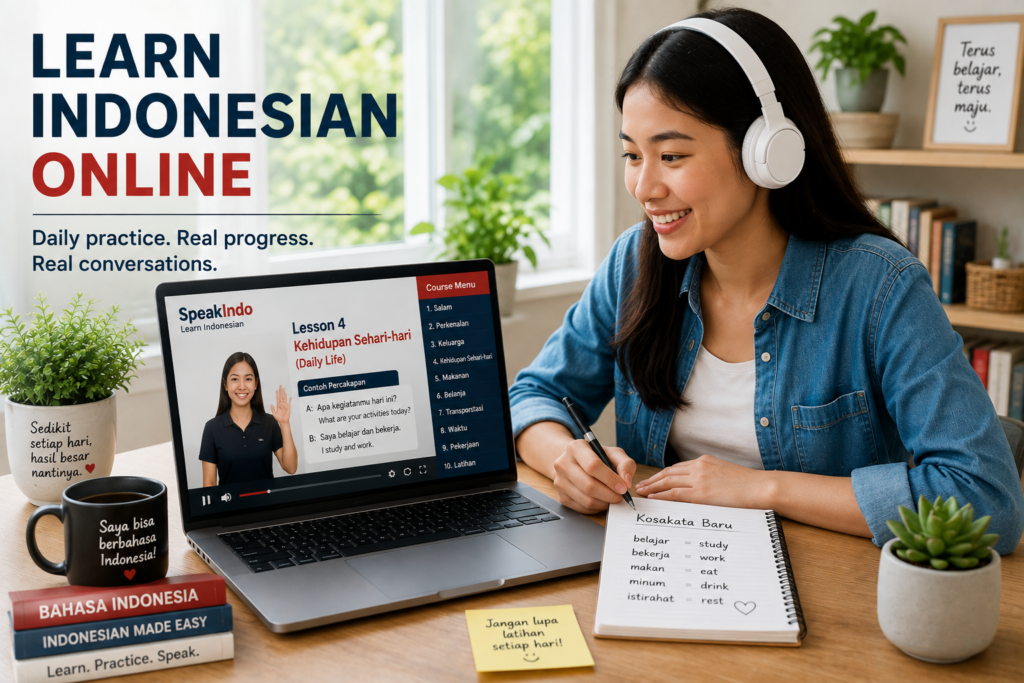
For many beginners, the hardest part is not understanding Indonesian. The real challenge is creating a routine and knowing what to study next. Random videos and apps may provide useful information, but they rarely create a complete learning path. SpeakIndo gives beginners a clear way forward. Lessons combine useful words, audio, reading, exercises, and speaking activities, allowing students to develop their Indonesian gradually while fitting study around everyday life.
Why Daily Practice Works
Learning a language is similar to developing any other skill. Regular practice usually works better than studying for several hours once in a while.
Imagine studying Indonesian for three hours on Sunday and then doing nothing for the rest of the week. By the following weekend, some of the material may already feel unfamiliar.
Now consider a different approach.
Spend fifteen minutes with Indonesian every day. Review words on Monday, practise listening on Tuesday, and repeat useful sentences on Wednesday. Later in the week, return to earlier material.
This routine keeps Indonesian fresh in your mind.
Small sessions also feel easier to manage, which can help you continue learning for longer.
Stop Collecting Random Learning Materials
Many beginners have several language apps on their phones.
Their browser may contain dozens of saved videos, vocabulary pages, and grammar explanations. Unfortunately, having more resources does not always create better results.
Too much choice can actually slow you down.
Today you study food vocabulary. Tomorrow you watch an advanced grammar video. A few days later, you find a lesson about slang.
Nothing connects.
A clear study plan removes this problem. Instead of asking, “What should I learn today?” you simply continue with the next topic.
That leaves more time for actual practice.

Start with Language You Can Use Today
Beginners do not need difficult Indonesian in their first lessons.
Useful language should come first.
A simple learning plan can begin with:
- Greetings and introductions
- Numbers and prices
- Food and drinks
- Family and friends
- Time and dates
- Shopping
- Travel and transport
- Everyday activities
These topics prepare learners for situations they may experience in real life.
For example, knowing how to introduce yourself can immediately lead to a short conversation. Learning numbers becomes useful when shopping, while food vocabulary can help at restaurants.
Practical language gives every lesson a clear purpose.
Build a Simple Indonesian Routine
You do not need to completely change your schedule to study another language.
Instead, connect Indonesian to activities that already happen during your day.
Morning can be used for five minutes of vocabulary review. During a break, listen to a short Indonesian recording. Later, repeat several phrases aloud.
A simple routine might include:
- Morning vocabulary review
- Short listening practice
- One video lesson
- Five spoken phrases
- Quick evening review
- Weekend recap
There is no need to complete every activity daily.
Choose a few that work for you and rotate them throughout the week.
Listen Before Trying to Understand Everything
Listening can feel difficult during the first weeks.
Native speakers may seem fast, and familiar words can be hard to recognise when they appear inside complete sentences.
Do not try to translate everything.
Listen for one familiar word first. On the second attempt, notice another phrase. After several repetitions, the general meaning may become clearer.
This process trains your ears gradually.
Regular listening also supports pronunciation. The more often you hear a word, the easier it becomes to copy its sound and rhythm.
Speak Indonesian from Your First Week
Waiting until you feel completely ready can delay progress.
You do not need hundreds of words before speaking.
Start with something easy:
Halo, nama saya Anna.
Hello, my name is Anna.
Later, add another sentence:
Saya tinggal di London.
I live in London.
Once these phrases feel comfortable, try asking a question.
Siapa nama Anda?
What is your name?
A conversation does not have to be long to count as practice. Even two or three sentences help train your brain to use Indonesian actively.
Confidence grows through these small experiences.
Use Your Environment as a Classroom
Online lessons provide structure, but learning can continue after you close your laptop.
Look around your home.
Choose five objects and learn their Indonesian names. During breakfast, practise words for food and drinks. When checking the time, try saying the hour in Indonesian.
Travelling provides even more opportunities.
If you are already in Indonesia, read signs and menus. Listen for familiar words in cafés or shops. Try using a simple Indonesian greeting instead of automatically speaking English.
Real-life connections make new language easier to remember.
What SpeakIndo Gives Beginners
SpeakIndo brings different learning activities together in one program.
Students do not have to search for separate materials every day.
The course includes:
- Step-by-step video lessons
- Indonesian audio practice
- Everyday vocabulary
- Reading activities
- Speaking exercises
- Lesson practice
- Quizzes
- Flexible online study
Each part supports a different skill.
Video introduces new material, while audio trains listening. Reading helps learners recognise vocabulary in context. Speaking activities encourage active use of the language.
Together, these elements create a clearer learning experience.
Learn Indonesian Online at Your Own Speed
Not every student learns in the same way.
One person may remember vocabulary quickly but struggle with pronunciation. Another learner might enjoy speaking while needing more time for listening.
Online study gives you room to adjust.
Replay difficult audio when necessary. Return to an older lesson if some vocabulary has been forgotten. When a topic feels easy, move forward.
There is no need to compete with other students.
Your progress belongs to you.
A steady pace that you can maintain is far more useful than rushing through lessons and forgetting the material later.
Make Mistakes Without Losing Confidence
Mistakes are unavoidable when learning a language.
A wrong word does not mean that your study session failed. In many cases, mistakes show exactly what you need to practise next.
Suppose you forget a word during a conversation. Look it up afterwards and use it again the following day.
That small mistake has now become a learning opportunity.
Try not to wait for perfect grammar either. At beginner level, clear communication is more important than creating complex sentences.
Use what you know and improve from there.
Who Can Benefit from Online Indonesian Learning?
People choose Indonesian for many reasons.
Travellers may want to communicate during a holiday in Bali, Java, Sumatra, or other parts of Indonesia. Expats often need the language for daily life.
International students can use basic Indonesian to connect with local people. Professionals may want better communication with Indonesian colleagues or clients.
Personal relationships provide another strong reason to learn. Speaking Indonesian with a partner, friend, or family member can make communication more meaningful.
Whatever your goal, regular practice creates the foundation for progress.
Keep Your Motivation Growing
Motivation changes from week to week.
Instead of waiting until you feel inspired, create small goals that are easy to achieve.
Your first goal might be learning ten useful phrases. Next, try understanding a short audio clip. Later, challenge yourself to introduce yourself without looking at notes.
Notice each improvement.
Being able to order a drink, understand a greeting, or answer a simple question may seem small. In reality, these moments show that your Indonesian is becoming useful.
Progress is often easier to see when you focus on what you can do rather than how much you still need to learn.
Continue Learning with SpeakIndo
When you learn Indonesian online, combining structured lessons with extra practice can make your learning experience stronger.
SpeakIndo already has several related resources. Add internal links in WordPress to these existing articles:
- Indonesian Vocabulary for Beginners
- Basic Indonesian Course
- Indonesian for Beginners
- Online Indonesian Lessons
- Indonesian Speaking Course
- Study Indonesian Online
These articles allow visitors to explore vocabulary, speaking, study habits, and beginner learning in more detail.
Internal links also connect your SpeakIndo content, making it easier for search engines to understand the main subject of your website.
For official Indonesian spelling and word meanings, learners can use KBBI, the official Indonesian dictionary.
Start Learning Indonesian Today
You do not need a perfect schedule before beginning.
Choose one lesson and start there. Listen carefully, learn a few useful words, and say them aloud. Tomorrow, spend a little time reviewing what you learned.
When you learn Indonesian online with SpeakIndo, you get a clear learning path while keeping the freedom to study when it suits you. Video, audio, vocabulary, reading, exercises, quizzes, and speaking practice work together to build practical language skills.
Most importantly, Indonesian can gradually become part of your daily life rather than something you only study occasionally.
Visit SpeakIndo and explore the beginner program today. Start with one lesson, practise regularly, and watch your confidence grow step by step.
Have a friend, partner, colleague, or family member who also wants to learn? Share SpeakIndo with them. Learning together creates more opportunities for conversation and gives both of you extra motivation to continue.